Trading Systems blogs
Home  
 
 
  Previous 10 Posts
  - Please Note
  - HiLite - APC
  - HiLite - CL
  - Real Life
  - Unconventional Success
  - A Dull Market
  - Oil Exes on Capitol Hill
  - Investing Tips
  - The Market Today
  - Expect Three More Fed Rate Hikes


Categories


Stock market
Stock Trading articles
Trading Blogs
Best of ...
Elite Traders
Elite Traders#2
Technical trading blogs
Day trading blogs


Archives

News for July, 2006

News for May, 2006

News for April, 2006

News for March, 2006

News for February, 2006

News for January, 2006


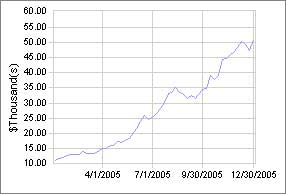
Equity curve for Trading System no2.

382% Model portfolio performance for 2005!


12 13 14 15 16 17 18 19 20 21 22 23 

 
Monday's Stockwatch
at 2005-11-12 23:55:02
Picks highlighted by pundits:
HAL:
Approaching support at 55. If bounce, go long. If break support, short. Since oil sector so risky right now, use tight stops.
MIK: Breaing out over resistace. Could be reversing downtrend with higher highs and lower lows. Place stop just under 32.50. (Fitzpartick pick)
SWIR: Breakout over resistance. (Chartman pick)
GIVN: Double bottome could break downtrend. Breakout at 25.24. Resistance 30. (Guy Lerner)

Charts : QCOM, LWSN, YHOO, COH, CUTR, ESCR, QDEL, APCS, EXPE, MMUS

Tony Blair tries to spark the EU economy
at 2005-11-12 23:55:02

The performance of the collective EU economy has been nothing short of pathetic in the last few years, and is set to grow at only 1.5% this year. As the current leader of the EU, British Prime Minister Tony Blair has been charged with spearheading the Euro-area economic turnaround. He has proposed a comprehensive plan for structural reforms, including less job security, fewer social safety nets, and government subsidized spending on research & development. It has been theorized that the socialized policies of the EU create few incentives to work and have resulted in massive unemployment. If EU member countries eliminate certain job protections, thereby restoring this incentive to work, it may ignite their respective economies and spark the Euro in the process. The Economist reports:

Growth has consistently lagged behind America’s in recent years, particularly in continental Europe, where unemployment rates often hover near double digits (well above 10% in the case


USD continues to outperform Asian currencies
at 2005-11-12 23:55:02

The USD has risen to a 25-month high against the Japanese Yen, including a 14% increase in this year alone. The Japanese economy has begun to show signs of life; its capital markets have performed those in the US, and Japan continues to run a massive current account surplus with the US. Hence, the USD’s continued appreciation against the Japanese Yen, and many other Asian currencies, has forex traders scratching their heads. Economists have turned to data on international capital flows in attempting to explain the weakness of Asian currencies. They believe rising US interest rates combined with the perceived stability of US capital markets are driving risk-averse investors, especially those in Asia, to shift capital into the US, which has generated massive demand for USD. The Wall Street Journal reports:

During the first eight months of this year, Japanese investors have poured $126 Billion into foreign stocks and bonds, up 19% from the same period last year.


ECB cools speculation over rate hike
at 2005-11-12 23:55:02

When Jean-Claude Trichet, President of the European Central Bank (ECB), hinted several weeks ago that the ECB was poised to raise interest rates, the Euro immediately jumped almost 2%. Today, however, Trichet sang a different tune, insisting a hike in interest rates was not indeed imminent. The announcement clearly came as a shock to economists and investors, many of whom had predicted the ECB would raise rates for the first time in two years, on the basis of Trichet’s earlier comments. According to the ECB, interest rates are at an appropriate level, whereby inflation is contained without constraining economic growth. Bloomberg News reports:

“Trichet was expected to be quite hawkish, so the euro is being sold on disappointment with the more dovish comments…The market will now be looking for signs that the rate hike [will happen in] December.�?

Read More: Why have the US and EU economies diverged?
at 2005-11-12 23:55:02

Over the last decade, the US economy has grown on average by 3% per year. Over the same period, the economies of the EU have collectively grown by 2%. In a new research paper, two prominent economists have attempted to make sense of this disparity. There theory is multifold, taking into account differences in government, education, and monetary policy. It is a combination of these three structures, they argue, that has driven the US economy to outperform that of the EU, and by extension, the perennial strength of the USD.

First, the US government is largely laissez-faire, meaning it attempts to allow capitalism and free markets to flourish, whenever possible. EU governments, in contrast, have attempted to implement socialist policies within a capitalist framework, including protectionist economic policies and jobs protections, which detract from economic growth. Next, the US government spends more money on education than their EU counterparts, and relatively more Americans h


12 13 14 15 16 17 18 19 20 21 22 23 


Home| Members Only | Trading Articles | Subscribe | FAQ | Disclaimer | Privacy policy