"To play devil's advocate...if your test shows the tide is against daytraders and against investors. Is the tide with those brave souls willing to hold overnight and dump their holdings the next day? Hold short-term? Long-term? What criteria are you using to determine the tide is with if you trade like yourself? Are you adjusting your exits depending on certain conditions? Scaling out? If so, possibly daytraders and investors can and most likely are doing the same. Plus, your test is only showing one instrument. What happens if you choose a different one? What happens if you diversify across several instruments. Or diversify across time? I could go on and on. There are so many ways to skin this cat...that it's very hard to discount one methodology over another." --
Michael Taylor
This is a great subject for writing about because it is hard to pin down all the angles. I can't resist ;-) Rather than process of elimination, let's discuss some of the important factors that all market participants must deal with because no matter what strategy you use, they are a factor. Off the top of my head some important ones are:
- commission
-
bid-ask spread
- margin interest
- taxes
- slippage
-
gaps
- dividends
- money market interest
- interest on short positions
- dividends paid out for short positions
Every trader should have a good understanding of how these factors affect each of their strategies and tactics. I bolded the two that I feel are immediately relevant to my previous post regarding daytrading and "investing". Before I tear into these strategies again, let me say that each has their place for a well rounded and properly capitalized trader.
Most people have probably given some thought to whether or not they feel that market prices have an infinite
fractal dimensionality or not. In otherwords, if I show you a chart of continuous prices I grabbed at random that doesn't have labels on the time axis and price axis, could you make a good guess about what time horizon and price range you were looking at? Could you do it repeatedly with any accuracy? For me, the answer is no. So I assume that daytraders in general are in fact trading the same kinds of chart patterns and price trends that I am, just on a different scale. The daytrader could employ twice as much leverage as I could, but he would also be paying the same bid-ask spread as I would have to. Regardless of how much leverage he chose to use, he's paying the spread on the whole thing, and when expressed as a percentage of his average profits, the bid-ask spread takes a ridiculously larger chunk of his profits using the same chart trading techniques! The daytrader also has a higher turnover, which means more chances for commission and slippage to eat into the profits.
"Ah," you might say, "but the daytrader could avoid the spread by using limit orders." That is correct, you can choose the time of your trade or the price of your trade, but the two are mutually exclusive. So our limit ordering daytrader can't even be sure that he will get the positions that his strategy requires him to have. Also, the best trades have a funny way of not quite getting to your limit anyway. There is no shortcut around the bid-ask spread that doesn't penalize you in another equally sinister way.
Let's not forget gaps. There is a mutually exclusive relationship to explore here as well, and it is all about liquidity. It is a fact that people will pay a premium to reduce their risk. If you can provide liquidity for these people and are good at selectively managing the risks involved, you will be paid a premium. Carrying stock positions overnight is one way of providing liquidity to people in aggregate. Any trader who's thought deeply about it understands that when he is successful in his trading operations, it just so happens that he has improved the liquidity of the market. He has bought when both supply was abundant and demand was scarce. He has sold when supply was both relatively scarce and demand relatively abundant.
Buy uncertainty and sell hope.
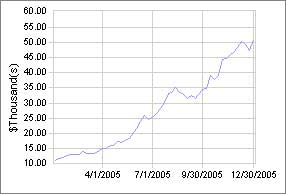
All these things are the tide that I'm talking about. It is quite convenient that you can see it on the price series of the QQQQ. I'm not saying that you can't be successful daytrading because there are zillions of people who are, but they are grinding it out in an uphill battle for reasons that are fundamental to the way markets work. On top of that, daytrading takes a LOT of time that could be spent on things equally as gratifying. I like the easy road.